Selasa, 05 Juli 2011

Mig-29 Fulcrum


The Mikoyan MiG-29 (Russian: Микоян МиГ-29; NATO reporting name: Fulcrum) is a fourth-generation jet fighter aircraftdesigned in the Soviet Union for an air superiority role. Developed in the 1970s by the Mikoyan design bureau, it entered service with the Soviet Air Force in 1983, and remains in use by the Russian Air Force as well as in many other nations. The NATO name "Fulcrum" was sometimes unofficially used by Soviet pilots in service.
The MiG-29, along with the Sukhoi Su-27, was developed to counter new American fighters such as the McDonnell Douglas F-15 Eagle, and the General Dynamics F-16 Fighting Falcon.

Minggu, 27 Maret 2011

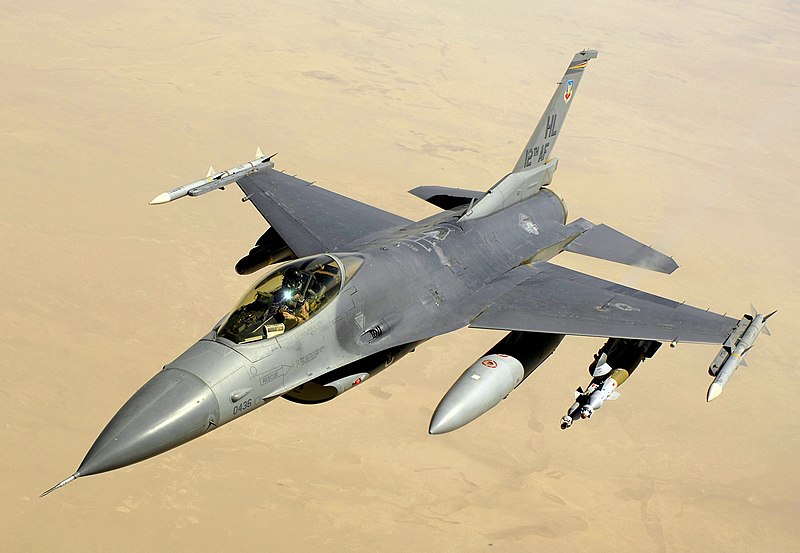
F-16 Fighting Falcon

File:F-16 June 2008.jpg

The General Dynamics F-16 Fighting Falcon is a multirole jet fighter aircraft originally developed by General Dynamics for the United States Air Force. Designed as a lightweight day fighter, it evolved into a successful all-weather multirole aircraft. Over 4,400 aircraft have been built since production was approved in 1976. Though no longer being purchased by the U.S. Air Force, improved versions are still being built for export customers. In 1993, General Dynamics sold its aircraft manufacturing business to the Lockheed Corporation, which in turn became part of Lockheed Martin after a 1995 merger with Martin Marietta.
The Fighting Falcon is a dogfighter with numerous innovations including a frameless bubble canopy for better visibility, side-mounted control stick to ease control while maneuvering, a seat reclined 30 degrees to reduce the effect of g-forces on the pilot, and the first use of a relaxed static stability/fly-by-wire flight control system that makes it a highly nimble aircraft. The F-16 has an internal M61 Vulcan cannon and has 11hardpoints for mounting weapons, and other mission equipment. Although the F-16's official name is "Fighting Falcon", it is known to its pilots as the "Viper", due to it resembling a viper snake and after the Battlestar Galactica Colonial Viper starfighter.
In addition to USAF active, reserve, and air national guard units, the aircraft is used by the USAF aerial demonstration team, the U.S. Air Force Thunderbirds, and as an adversary/aggressor aircraft by the United States Navy. The F-16 has also been procured to serve in the air forces of 25 other nations.

Minggu, 06 Maret 2011

Dassault Mirage III


The Mirage III is a supersonic fighter aircraft designed in France by Dassault Aviation during the late 1950s, and manufactured both in France and a number of other countries. It was a successful fighter aircraft, being sold to many air forces around the world and remaining in production for over a decade. Some of the world's smaller air forces still fly Mirage IIIs or variants as front-line equipment today.

Rabu, 16 Februari 2011

MIG-21 Fishbed


The Mikoyan-Gurevich MiG-21 (Russian: Микоян и Гуревич МиГ-21; NATO reporting name "Fishbed") is a supersonic jet fighter aircraft, designed by the Mikoyan-Gurevich Design Bureau in the Soviet Union. It was popularly nicknamed "balalaika", from the aircraft's planform-view resemblance to the Russian stringed musical instrument or ołówek (English: pencil) by Polish pilots due to the shape of its fuselage. Early versions are considered second-generation jet fighters, while later versions are considered to be third-generation jet fighters. Some 50 countries over four continents have flown the MiG-21, and it still serves many nations a half-century after its maiden flight. The fighter made aviation records. At least by name, it is the most-produced supersonic jet aircraft in aviation history and the most-produced combat aircraft since theKorean War, and it had the longest production run of a combat aircraft (1959 to 1985 over all variants).

Jumat, 04 Februari 2011

F-86 Sabre


File:North American F86-01.JPG
The North American F-86 Sabre (sometimes called the Sabrejet) was a transonic jet fighter aircraft. Produced by North American Aviation, the Sabre is best known for its Korean War role, where it was pitted against the Soviet MiG-15. Although developed in the late 1940s and outdated by the end of the 1950s, the Sabre proved adaptable and continued as a front line fighter in air forces until the last active front line examples were retired by the Bolivian Air Force in 1994.
Its success led to an extended production run of more than 7,800 aircraft between 1949 and 1956, in the United States, Japan and Italy. It was by far the most-produced Western jet fighter, with total production of all variants at 9,860 units.
Variants were built in Canada and Australia. The Canadair Sabre added another 1,815 airframes, and the significantly redesigned CAC Sabre(sometimes known as the Avon Sabre or CAC CA-27), had a production run of 112.

Minggu, 23 Januari 2011

Messerschmitt ME-262


File:Messerschmitt Me 262A at the National Museum of the USAF.jpg
The Messerschmitt Me 262 Schwalbe ("Swallow") was the world's first operational jet-powered fighter aircraft. Design work started beforeWorld War II began, but engine problems prevented the aircraft from attaining operational status until mid-1944. Compared with Allied fighters of its day, including the jet-powered Gloster Meteor, it was much faster and better armed.
In combat, when properly flown, it proved difficult to counter due to its speed. Me 262 pilots claimed a total of 509 Allied kills (although higher claims are sometimes made) against the loss of about 100 Me 262s. The design was pressed into a variety of roles, including light bomber, reconnaissance and even experimental night fighter versions.
The Me 262 is considered to have been the most advanced German aviation design in operational use during World War II. The Allies countered its potential effectiveness in the air by relentlessly attacking the aircraft on the ground, or while they were taking off or landing. Maintenance during the deteriorating war situation and a lack of fuel also reduced the effectiveness of the aircraft as a fighting force. In the end, the Me 262 had a negligible impact on the course of the war due to its late introduction and the small numbers that were deployed in operational service.
The Me 262 influenced the designs of post-war aircraft such as the North American F-86 and Boeing B-47.

Rabu, 05 Januari 2011

Sukhoi PAK FA T-50


File:Pak fa in flight.jpg
The Sukhoi PAK FA (Russian: Перспективный авиационный комплекс фронтовой авиацииPerspektivny aviatsionny kompleks frontovoy aviatsii, literally "Prospective Airborne Complex - Frontline Aviation") is a fifth-generation jet fighter being developed by Sukhoi OKB for theRussian Air Force.
The current prototype is Sukhoi's T-50. The PAK FA, when fully developed, is intended to replace the MiG-29 Fulcrum and Su-27 Flanker in the Russian inventory and serve as the basis of the Sukhoi/HAL FGFA project being developed with India. A fifth generation jet fighter, it is designed to directly compete with Lockheed Martin's F-22 Raptor and F-35 Lightning II. The T-50 performed its first flight January 29, 2010. Its second flight was on February 6 and its third on February 12. As of August 31, 2010, it made 17 flights and by mid November 40 in total. The second prototype was to start its flight test by the end of 2010, but this has been delayed until 2011.
Sukhoi director Mikhail Pogosyan has projected a market for 1,000 aircraft over the next four decades, which will be produced in a joint venture with India, two hundred each for Russia and India and six hundred for other countries. He has also said that the Indian contribution would be in the form of joint work under the current agreement rather than as a joint venture. The Indian Air Force will "acquire 50 single-seater fighters of the Russian version" before the two seat FGFA is developed. The Russian Defense Ministry will purchase the first ten aircraft after 2012 and then 60 after 2016. The first batch of fighters will be delivered without the "Fifth generation" engines. Ruslan Pukhov, director of the Centre for Analysis of Strategies and Technologies, has projected that Vietnam will be the second export customer for the fighter. The PAK-FA is expected to have a service life of about 30–35 years.