
The Messerschmitt Me 262 Schwalbe ("Swallow") was the world's first operational jet-powered fighter aircraft. Design work started beforeWorld War II began, but engine problems prevented the aircraft from attaining operational status until mid-1944. Compared with Allied fighters of its day, including the jet-powered Gloster Meteor, it was much faster and better armed.
In combat, when properly flown, it proved difficult to counter due to its speed. Me 262 pilots claimed a total of 509 Allied kills (although higher claims are sometimes made) against the loss of about 100 Me 262s. The design was pressed into a variety of roles, including light bomber, reconnaissance and even experimental night fighter versions.
The Me 262 is considered to have been the most advanced German aviation design in operational use during World War II. The Allies countered its potential effectiveness in the air by relentlessly attacking the aircraft on the ground, or while they were taking off or landing. Maintenance during the deteriorating war situation and a lack of fuel also reduced the effectiveness of the aircraft as a fighting force. In the end, the Me 262 had a negligible impact on the course of the war due to its late introduction and the small numbers that were deployed in operational service.
The Me 262 influenced the designs of post-war aircraft such as the North American F-86 and Boeing B-47.
DESIGN & DEVELOPMENT
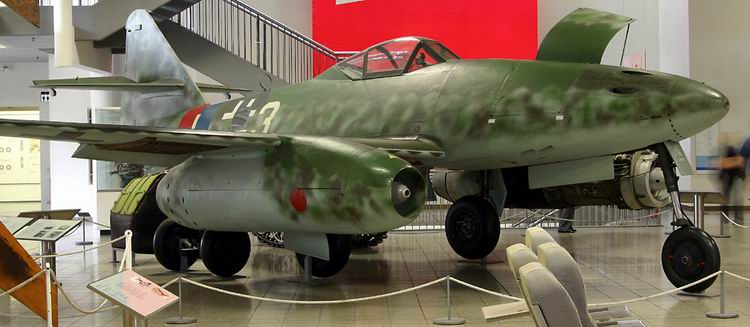
The Me 262 was already being developed as Projekt P.1065 before the start of World War II. Plans were first drawn up in April 1939, and the original design was very similar to the plane that eventually entered service. The progression of the original design into service was delayed greatly by technical issues involving the new jet engines. Funding for the jet program was also initially lacking as many high-ranking officials thought the war could easily be won with conventional aircraft. Among those was Hermann Göring, head of the Luftwaffe, who cut back the engine development program to just 35 engineers in February 1940, Willy Messerschmitt, who desired to maintain mass production of the Bf 109 and the projected Me 209, and Major General Adolf Galland, who supported Messerschmitt through the early development years, flying the Me 262 himself on 22 April 1943. By that time problems with engine development had slowed production of the aircraft considerably.
In mid-1943 Adolf Hitler envisioned the Me 262 as an offensive ground-attack/bomber rather than a defensive interceptor. The configuration of a high speed, light payload Schnellbomber ("Fast Bomber") was intended to penetrate enemy air superiority during the expected Allied invasion of France. His edict resulted in the development of (and concentration on) the Sturmvogel variant. It is debatable to what extent Hitler's interference extended the delay in bringing the Schwalbe into operation. Albert Speer, then Minister of Armaments and War Production, claimed in his memoirs Hitler originally blocked mass-production of the Me 262 before agreeing in early 1944. He rejected arguments the aircraft would be more effective as a fighter against Allied bombers then destroying large parts of Germany and wanted it as a bomber for revenge attacks. According to Speer, Hitler felt its superior speed compared to other fighters of the era meant it could not be attacked and so preferred it for high altitude straight flying.
Although it is often stated the Me 262 is a "swept wing" design, the production Me 262 had a leading edge sweep of only 18.5°, too slight to achieve any significant advantage in increasing the critical Mach number. Sweep was added after the initial design of the aircraft, when the engines proved to be heavier than originally expected, primarily to position the center of lift properly relative to the centre of mass. 1 March 1940, instead of moving the wing forward on its mount, the outer wing was repositioned slightly aft. The trailing edge of the mid-section of the wing remained unswept. Based on data from the AVA Göttingen and windtunnel results, the middle section's leading edge was later swept to the same angle as the outer panels.
The first test flights began on 18 April 1941, with the Me 262 V1 example, bearing its Stammkennzeichen radio code letters of PC+UA, but since its intended BMW 003 turbojets were not ready for fitting, a conventional Junkers Jumo 210 engine was mounted in the V1 prototype's nose, driving a propeller, to test the Me 262 V1 airframe. When the BMW 003 engines were finally installed, the Jumo was retained for safety, which proved wise as both 003s failed during the first flight and the pilot had to land using the nose-mounted engine alone.
The aircraft was originally designed with a tailwheel undercarriage and the first four prototypes (Me 262 V1-V4) were built with this configuration, but it was discovered on an early test run that the engines and wings "blanked" the stabilizers, giving almost no control on the ground, as well as serious runway surface damage from the hot jet exhaust. Changing to a tricycle undercarriage arrangement, initially a fixed undercarriage on the "V5" fifth prototype, then fully retractable on the sixth (V6, with Stammkennzeichen code VI+AA) and succeeding aircraft, corrected this problem.The V3 third prototype airframe, with the code PC+UC, became a true "jet" when it flew on 18 July 1942 in Leipheim near Günzburg, Germany, piloted byFritz Wendel. This was almost nine months ahead of the British Gloster Meteor's first flight on 5 March 1943. The conventional gear, forcing a tail-down attitude on the ground, of the Me 262 V3 caused its jet exhaust to deflect off the runway, with the wing's turbulence negating the effects of the elevators in the tail-down attitude, and the first attempt was cut short. On the second attempt, Wendel solved the problem by tapping the aircraft's brakes at takeoff speed, lifting the horizontal tail above and out of the wing's turbulence.
The BMW 003 jet engines, which were proving unreliable, were replaced by the newly available Junkers Jumo 004. Test flights continued over the next year, but the engines continued to be unreliable. Airframe modifications were complete by 1942, but hampered by the lack of engines, serial production did not begin until 1944, but deliveries were low, with 28 Me 262s in June, 59 in July, but only 20 in August. This delay in engine availability was in part due to the shortage of strategic materials, especially metals and alloys able to handle the extreme temperatures produced by the jet engine. Even when the engines were completed, they had an expected operational lifetime of approximately 50 continuous flight hours; most 004s lasted just 12 hours, even with adequate maintenance. A pilot familiar with the Me 262 and its engines could expect approximately 20–25 hours of life from the 004s. Changing a 004 engine was intended to require three hours, but this typically took eight to nine due to poorly made parts and inadequate training of ground crews.
Turbojet engines have less thrust at low speed than propellers, and as a result, low-speed acceleration is relatively poor. It was more noticeable for the Me 262 as early jet engines (before the invention of afterburners) responded slowly to throttle changes. The introduction of a primitive autothrottle late in the war only helped slightly. Conversely, the higher power of jet engines at higher speeds meant the Me 262 enjoyed a much higher rate of climb. Used tactically, this gave the jet fighter an even greater speed advantage in climb rate than level flight at top speed.
With one engine out, the Me 262 still flew well, with speeds of 450–500 km/h (280–310 mph), but pilots were warned never to fly slower than 300 km/h (190 mph) on one engine, as the asymmetrical thrust would cause serious problems.
Operationally, the Me 262 had an endurance of 60 to 90 minutes.
OPERATIONAL HISTORY

In April 1944, Erprobungskommando 262 was formed at Lechfeld just south of Augsburg, Bavaria as a test unit (Jäger Erprobungskommando Thierfelder) to introduce the 262 into service and train a core of pilots to fly it. On 26 July 1944, Leutnant Alfred Schreiber with the 262 A-1a W.Nr. 130 017 damaged aMosquito reconnaissance aircraft of No. 540 Squadron RAF PR Squadron, which was allegedly lost in a crash landing upon landing at an air base in Italy. Other sources state the aircraft was damaged during evasive manoeuvres and escaped. It was the first victory for a turbojet fighter aircraft in aviation history. Major Walter Nowotny was assigned as commander after the death of Werner Thierfelder in July 1944, and the unit redesignated Kommando Nowotny. Essentially a trials and development unit, it holds the distinction of having mounted the world's first jet fighter operations. Trials continued slowly, with initial operational missions against the Allies in August 1944 allegedly downing 19 Allied aircraft for six Me 262s lost, although these claims have never been verified by cross-checking with USAAF records. The RAF Museum holds no intelligence reports of RAF aircraft engaging in combat with Me 262s in August, although there is a report of an unarmed encounter between an Me 262 and a Mosquito. Despite orders to stay grounded, Nowotny chose to fly a mission against an enemy bomber formation flying some 30,000 feet above, on 8 November 1944. He claimed two P-51Ds destroyed before suffering engine failure at high altitude. Then, while diving and trying desperately to restart his engines, he was attacked and forced to bail out by other Mustangs. Some US historians proposed that Nowotny's victor was P-51D pilot Lt Robert W Stevens of the 364thFG According to other sources, he was shot down and killed by First Lieutenant Edward "Buddy" Haydon of the 357th Fighter Group, USAAF and Captain Ernest "Feeb" Fiebelkorn of the 20th Fighter Group, USAAF.
Actually, the exact circumstances surrounding the end of Walter Nowotny remain uncertain to this day. It is also possible that he was hit by "friendly" flak. The Kommando was then withdrawn for further training and a revision of combat tactics to optimise the 262's strengths.
Jagdverband 44 (JV 44) was another Me 262 fighter unit, of Staffel (squadron) size given the low numbers of available personnel, formed in February 1945 byLieutenant General Adolf Galland, who had recently been dismissed as Inspector of Fighters. Galland was able to draw into the unit many of the most experienced and decorated Luftwaffe fighter pilots from other units grounded by lack of fuel.By January 1945, Jagdgeschwader 7 (JG 7) had been formed as a pure jet fighter wing, although it would be several weeks before it was operational. In the meantime, a bomber unit – I Gruppe, Kampfgeschwader 54 (KG 54) – had re-equipped with the Me 262 A-2a fighter-bomber for use in a ground-attack role. However, the unit lost 12 jets in action in two weeks for minimal returns.
During March, Me 262 fighter units were able, for the first time, to mount large scale attacks on Allied bomber formations. On 18 March 1945, 37 Me 262s of JG 7 intercepted a force of 1,221 bombers and 632 escorting fighters. They shot down 12 bombers and one fighter for the loss of three Me 262s. Although a 4:1 ratio was exactly what the Luftwaffe would have needed to make an impact on the war, the absolute scale of their success was minor, as it represented only one per cent of the attacking force. In 1943 and early 1944, the USAAF had been able to keep up offensive operations despite loss ratios of 5% and more, and the few available Me 262s could not inflict sufficient losses to hamper their operations.
Despite its deficiencies, the Me 262 clearly signaled the beginning of the end of piston-engined aircraft as effective fighting machines. Once airborne, it could accelerate to speeds well over 800 km/h (500 mph), over 150 km/h (90 mph) faster than any Allied fighter operational in the European Theater of Operations.Several two-seat trainer variants of the Me 262, the Me 262 B-1a, had been adapted through the Umrüst-Bausatz 1 factory refit package as night fighters, complete with on-board FuG 218 Neptun high-VHF band radar, using Hirschgeweih ("stag's antlers") antennae with a set of shorter dipole elements than theLichtenstein SN-2 had used, as the B-1a/U1 version. Serving with 10 Staffel, Nachtjagdgeschwader 11, near Berlin, these few aircraft (alongside several single-seat examples) accounted for most of the 13 Mosquitoes lost over Berlin in the first three months of 1945. However, actual intercepts were generally or entirely made using Wilde Sau methods, rather than AI radar-controlled interception. As the two-seat trainer was largely unavailable, many pilots had to make their first flight in a jet in a single-seater without an instructor.
The Me 262's top ace was probably Hauptmann Franz Schall with 17 kills which included six four-engine bombers and 10 P-51 Mustang fighters, although night fighter ace Oberleutnant Kurt Welter claimed 25 Mosquitos and two four-engine bombers shot down by night and two further Mosquitos by day flying the Me 262. Most of Welter's claimed night kills were achieved in standard radar-less aircraft, even though Welter had tested a prototype Me 262 fitted with FuG 218 Neptun radar. Another candidate for top ace on the aircraft was Oberstleutnant Heinrich Bär, who claimed 16 enemy aircraft while flying the Me 262.
SPECIFICATIONS

General characteristics
- Crew: 1
- Length: 10.60 m (34 ft 9 in)
- Wingspan: 12.60 m (41 ft 6 in)
- Height: 3.50 m (11 ft 6 in)
- Wing area: 21.7 m² (234 ft²)
- Empty weight: 3,795 kg (8,366 lb)
- Loaded weight: 6,473 kg (14,272 lb)
- Max takeoff weight: 7,130 kg (15,720 lb)
- Powerplant: 2× Junkers Jumo 004 B-1 turbojets, 8.8 kN (1,980 lbf) each
- Aspect ratio: 7.32
Performance
- Maximum speed: 900 km/h (559 mph)
- Range: 1,050 km (652 mi)
- Service ceiling: 11,450 m (37,565 ft)
- Rate of climb: 1,200 m/min (At max weight of 7,130 kg) (3,900 ft/min)
- Thrust/weight: 0.28
Armament
- Guns: 4 × 30 mm MK 108 cannons (A-2a: two cannons)
- Rockets: 24 × 55 mm (2.2 in) R4M rockets
- Bombs: 2 × 250 kg (551 lb) bombs or 2 × 500 kg (1,102 lb) bombs (A-2a only)

Tidak ada komentar:
Posting Komentar