
The Mikoyan-Gurevich MiG-21 (Russian: Микоян и Гуревич МиГ-21; NATO reporting name "Fishbed") is a supersonic jet fighter aircraft, designed by the Mikoyan-Gurevich Design Bureau in the Soviet Union. It was popularly nicknamed "balalaika", from the aircraft's planform-view resemblance to the Russian stringed musical instrument or ołówek (English: pencil) by Polish pilots due to the shape of its fuselage. Early versions are considered second-generation jet fighters, while later versions are considered to be third-generation jet fighters. Some 50 countries over four continents have flown the MiG-21, and it still serves many nations a half-century after its maiden flight. The fighter made aviation records. At least by name, it is the most-produced supersonic jet aircraft in aviation history and the most-produced combat aircraft since theKorean War, and it had the longest production run of a combat aircraft (1959 to 1985 over all variants).
DEVELOPMENT

The MiG-21 jet fighter was a continuation of Soviet jet fighters, starting with the subsonic MiG-15 and MiG-17, and the supersonic MiG-19. A number of experimental Mach 2 Soviet designs were based on nose intakes with either swept-back wings, such as the Sukhoi Su-7, or tailed deltas, of which the MiG-21 would be the most successful.
Development of what would become the MiG-21 began in the early 1950s, when Mikoyan OKB finished a preliminary design study for aprototype designated Ye-1 in 1954. This project was very quickly reworked when it was determined that the planned engine was underpowered; the redesign led to the second prototype, the Ye-2. Both these and other early prototypes featured swept wings—the first prototype with delta wings as found on production variants was the Ye-4. The Ye-4 made its maiden flight on 16 June 1955 and made its first public appearance during the Soviet Aviation Day display at Moscow's Tushino Airport in July 1956. The MiG-21 was the first successful Soviet aircraft combining fighter and interceptor characteristics in a single aircraft. It was a lightweight fighter, achieving Mach 2 with a relatively low-powered afterburning turbojet, and is thus comparable to the American Lockheed F-104 Starfighter and Northrop F-5 Freedom Fighter and the French Dassault Mirage III. Its basic layout was used for numerous other Soviet designs; delta-winged aircraft included Su-9 interceptor and the fast E-150 prototype from MiG bureau while the mass-produced successful front fighter Su-7 and Mikoyan`s I-75 experimental interceptor combined a similar fuselage shape with swept-back wings. However, the characteristic layout with the shock cone and front air intake did not see widespread use outside the USSR and finally proved to have limited development potential, mainly because of the very small space available for the radar.
Like many aircraft designed as interceptors, the MiG-21 had a short range. This was not helped by a design defect where the center of gravity shifted rearwards once two-thirds of the fuel had been used. This had the effect of making the plane uncontrollable, resulting in an endurance of only 45 minutes in clean condition. The issue of the short endurance and low fuel capacity of the MiG-21F, PF, PFM, S/SM and M/MF variants—though each had a somewhat greater fuel capacity than its predecessor—led to the development of the MT and SMT variants. These had a range increase of 250 km (155 mi) compared to the MiG-21SM, but at the cost of worsening all other performance figures (such as a lower service ceiling and slower time to altitude).
The delta wing, while excellent for a fast-climbing interceptor, meant any form of turning combat led to a rapid loss of speed. However, the light loading of the aircraft could mean that a climb rate of 235 m/s (46,250 ft/min) was possible with a combat-loaded MiG-21bis, not far short of the performance of the later F-16A. Given a skilled pilot and capable missiles, it could give a good account of itself against contemporary fighters. It was replaced by the newer variable-geometry MiG-23 and MiG-27 for ground support duties. However, not until the MiG-29 would the Soviet Union ultimately replace the MiG-21 as a maneuvering dogfighter to counter new American air superiority types.
The MiG-21 was exported widely and continues to be used. The aircraft's simple controls, engine, weapons, and avionics were typical of Soviet-era military designs. The use of a tail with the delta wing aids stability and control at the extremes of the flight envelope, enhancing safety for lower-skilled pilots; this in turn enhanced its marketability in exports to developing countries with limited training programs and restricted pilot pools. While technologically inferior to the more advanced fighters it often faced, low production and maintenance costs made it a favorite of nations buying Eastern Bloc military hardware. Several Russian, Israeli and Romanian firms have begun to offer upgrade packages to MiG-21 operators, designed to bring the aircraft up to a modern standard, with greatly upgraded avionics and armaments.
Due to the lack of available information, early details of the MiG-21 were often confused with those of the similar Sukhoi fighters also under development. Jane's All the World's Aircraft 1960–1961describes the "Fishbed" as a Sukhoi design, and uses an illustration of the Su-9 'Fishpot'.
OPERATIONAL HISTORY

Indo-Pakistani War of 1971
The expansion of IAF MiG-21 fleet marked a growing India-Soviet Union military partnership which enabled India to field a formidable air force to counter Chinese and Pakistani threats. The capabilities of the MiG-21 and the skills of its Indian pilots were soon put to the test during the Indo-Pakistani War of 1971. During the war, the MiG-21s played a crucial role in giving the IAF complete air superiority over vital points and areas in the western theater of the conflict.
The 1971 war witnessed the first supersonic air combat in the subcontinent when an Indian MiG-21FLs shot down a PAF F-104 Starfighter with its GSh-23 twin-barrelled 23 mm cannon. By the time the hostilities came to an end, the IAF MiG-21s had shot down four PAF F-104s, two PAF F.6, one PAF North American F-86 Sabre and one PAF Lockheed C-130 Hercules. According to Western military analysts, the MiG-21s had clearly "won" the much anticipated air combat between the MiG-21 and the F-104 Starfighter.
Because of the formidable performance of the MiG-21s, several nations, including Iraq, approached India for MiG-21 pilot training. By the early 1970s, more than 120 Iraqi pilots were being trained by the Indian Air Force.
Kargil War and Atlantique Incident
It was also used as late as 1999 in the Kargil War, in which one Indian Air Force MiG-21 was shot down by a Pakistani hand-held "Stinger" surface-to-air missile. The MiG-21's last known kill took place in 1999 during the Atlantique Incident, when two MiG-21 aircraft of the Indian Air Force intercepted and shot down an Breguet Atlantique reconnaissance aircraft of the Pakistani Navy with the R-60MK (AA-8 Aphid) air-to-air missile.
Vietnam
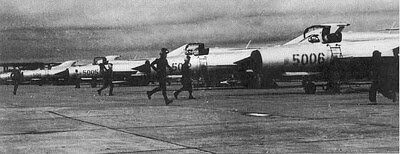
Although thirteen of North Vietnam's flying aces attained their status while flying the MiG-21 - versus just three in the MiG-17 - it is thought by many that North Vietnamese pilots preferred the MiG-17, since the high wing loading of the MiG-21 made it relatively less maneuverable, and the less heavily framed canopy of the MiG-17 gave greater visibility. However, this is not the impression perceived by British author Roger Boniface when he interviewed Pham Ngoc Lan and ace Nguyễn Nhật Chiêu (who scored victories flying both MiG-17 and MiG-21) - Pham Ngoc Lan told Boniface that "The MiG-21 was much faster, and it had two ATOLL missiles which were very accurate and reliable when fired between 1,000 and 1,200 yards.", and Nguyễn Nhật Chiêu asserted that "...for me personally I preferred the MiG-21 because it was superior in all specifications in climb, speed and armament. The ATOLL missile was very accurate and I scored four kills with the ATOLL. [...] In general combat conditions I was always confident of a kill over a F-4 Phantom when flying a MiG-21."The MiG-21, which initially achieved renown during the Vietnam War, in which it saw extensive action, was designed for very short ground-controlled interception (GCI) missions, which is precisely the type of missions that it was employed for in the skies over North Vietnam. The first MiG-21s arrived directly from the Soviet Union by ship in April 1966, and after being unloaded and assembled, were transitioned into North Vietnam's oldest fighter unit; the 921st Fighter Regiment, which had been established on 3 February 1964 as a MiG-17 unit. Since the North Vietnamese Air Force's 923rd FR was newer and less experienced, they would continue to operate strictly MiG-17s; while the arrival of the MiG-19's (J6 versions) from Communist China in 1969 would create North Vietnam's only MiG-19 unit, the 925th FR. On 3 February 1972, North Vietnam commissioned their fourth and last Fighter Regiment of the war while engaged with the United States, the MiG-21PFM (Type 94) equipped 927th Fighter Regiment.
Although the MiG-21 lacked the long-range radar, missiles, and heavy bombing payload of its contemporary multi-mission U.S. fighters, it proved a challenging adversary in the hands of experienced pilots, especially when used in high speed hit and run attacks under GCI control. MiG-21 intercepts of Republic F-105 strike groups were effective in downing US aircraft or forcing them to jettison their bomb loads.
After a million sorties and nearly 1,000 US aircraft losses, Operation Rolling Thunder came to an end on 1 November 1968. A poor air-to-air combat loss-exchange ratios against the smaller, more agile enemy MiGs during the early part of the Vietnam War eventually led the USN to create their Navy Fighter Weapons School, also known as "Top Gun" at Miramar Naval Air Station on 3 March 1969. The USAF quickly followed with their own version, titled the Dissimilar Air Combat Training (sometimes referred to as Red Flag) program. These two programs employed the subsonic Douglas A-4 Skyhawk and the supersonic F-5 Tiger II, as well as the Mach 2.4-capable USAF Convair F-106 Delta Dart, which mimicked the MiG-21. Over the course of the air war, between 3 April 1965 and 8 January 1973, each side would ultimately claim favorable kill ratios.
Two MiG-21s were claimed shot down by U.S. Air Force B-52 Stratofortress tail gunners; the only confirmed air-to-air kills made by the B-52. The first aerial victory occurred on 18 December 1972, kill awarded to tail gunner SSgt Samuel Turner, who was awarded the Silver Star for his feat. The second air to air kill took place on 24 December 1972, kill awarded to A1C Albert E. Moore for downing a MiG-21 over the Thai Nguyen railroad yards. Both actions occurred during Operation Linebacker II (also known as the Christmas Bombings).
The biggest threat to North Vietnam during the war, had always been the Strategic Air Command's B-52 Stratofortress. Hanoi's MiG-17 and MiG-19 interceptors could not deal with those bombers at the altitude that they flew. In the summer of 1972, the NVAF was directed to train 12 MiG-21 pilots for the specific mission of attacking and shooting down B-52 bombers; with two-thirds of those pilots specifically trained in the night attack. On 26 December 1972, just two days after Tail gunner Albert Moore downed his MiG-21, a VPAF (North Vietnamese Air Force) MiG-21MF (number 5121) from the 921st Fighter Regiment, flown by Major Phạm Tuân over Hanoi, North Vietnam claimed responsibility for the first aerial combat kill of a USAF Boeing B-52 Stratofortress in aviation history. The Stratofortress had been above Hanoi at over 30,000 feet (9,100 m) during Operation Linebacker II, when Major Tuân launched two Atoll missiles from 2 kilometres, claiming to have destroyed one of the bombers flying in the three plane formation. Other sources argue that his missiles failed to hit their mark, but as he was disengaging a B-52 from a three-bomber cell in front of his target took a hit from a SAM, exploding in mid-air: this may have caused Tuan to think his missiles destroyed the target he had been aiming for.
The Vietnamese side also claims another kill to have taken place on 28 December 1972 by a MiG-21 from the 921st FR, this time flown by Vu Xuan Thieu. Thieu is said to perished in the explosion of a B-52 hit by his own missiles, having approached the target too closely. In this case the Vietnamese version appears to be a complete fabrication: while one MiG-21 kill was claimed by Phantoms that night (this may have been Thieu's MiG), no B-52s were lost to any cause on the date of the claimed kill.
The MiG-21's 3G limit on maneuverability at altitude and the limited arc from which its weapons could be launched contributed to the poor results.
Egyptian-Syrian-Israeli conflicts
During the opening attacks of the 1967 Six Day War, the Israeli Air Force struck Arab air forces in four attack waves. In the first wave, IDF aircraft claimed to have destroyed eight Egyptian aircraft in air-to-air combat, of which seven were MiG-21s; Egypt claims 10 Israeli aircraft destroyed, four or five of which were scored by MiG-21PFs. During the second wave the Israelis claimed four MiG-21s downed in air-to-air combat, and the third wave resulted in two Syrian and one Iraqi MiG-21s claimed destroyed in the air. The fourth wave destroyed some more Syrian MiG-21s on the ground. Overall, the Egyptians lost around 100 out of about 110 MiG-21s they had, almost all on the ground; the Syrians lost 35 of 60 MiG-21F-13s and MiG-21PFs in the air and on the ground. The MiG-21 was also used extensively in the Middle East conflicts of the 1960s, 1970s and 1980s by the air forces of Egypt, Syria and Iraq. The MiG-21 first encountered Israeli Mirage IIICs on 14 November 1964, but it was not until 14 July 1966 that the first MiG-21 was shot down. Another six Syrian MiG-21s were shot down by Israeli Mirages on 7 April 1967. The MiG-21 would also face F-4 Phantom IIs and A-4 Skyhawks, but was later outclassed by the more modern McDonnell Douglas F-15 Eagle and F-16 Fighting Falcon, which were acquired by Israel beginning in the mid-1970s.
Between the end of the Six Day War and the start of the War of Attrition, IDF Mirage fighters had six confirmed kills of Egyptian MiG-21s, in exchange for Egyptian MiG-21s scoring two confirmed and three probable kills against Israeli aircraft. During the War of Attrition itself, the Israelis claimed 56 confirmed kills against Egyptian MiG-21s, while Egyptian MiG-21s claimed 14 confirmed and 12 probable kills against IDF aircraft. During this same time period, from the end of the Six Day War to the end of the War of Attrition, the Israelis claimed a total of 25 Syrian MiG-21s destroyed; the Syrians claimed three confirmed and four probable kills of Israel aircraft.
High losses to Egyptian aircraft and continuous bombing during the War of Attrition caused the Egyptians to ask the Soviet Union for help. In June 1970, Soviet pilots and SAM crews arrived with their equipment. On 22 June 1970, a Soviet pilot flying a MiG-21MF shot down an Israeli A-4E. After some more successful intercepts by Soviet pilots and another Israeli A-4 being shot down on July 25, the Israelis decided to plan an ambush in response. On July 30 Israeli F-4s lured Soviet MiG-21s into an area where they were ambushed by Mirages. Asher Snir, flying a Mirage IIICJ, destroyed a Soviet MiG-21; Avihu Ben-Nun and Aviam Sela, both piloting F-4Es, each got a kill, and an unidentified pilot in another Mirage scored the fourth kill against the Soviet-flown MiG-21s. Three Soviet pilots were killed and the Soviets were alarmed by the losses. However, Soviet MiG-21 pilots and SAM crews destroyed a total of 21 Israeli aircraft, which helped to convince the Israelis to sign a ceasefire agreement.
In September 1973 a large air battle erupted between the Syrians and the Israelis; the Israelis claimed a total of 12 Syrian MiG-21s destroyed, while the Syrians claimed eight kills scored by MiG-21s and admitted five losses.
During the Yom Kippur War, the Israelis claimed a total of 73 kills of Egyptian MiG-21s. Egypt claimed 27 kills of Israeli aircraft by its MiG-21s, plus eight probables. However, according to most reliable sources, these were exaggerated claims as Israeli air-to-air combat losses for the entire war did not exceed 5 to 8.
On the Syrian front of the war, 6 October 1973 saw a flight of Syrian MiG-21MFs shoot down an IDF A-4E and a Mirage IIICJ while losing three of their own to Israeli IAI Neshers. On 7 October, Syrian MiG-21MFs downed two Israeli F-4Es, three Mirage IIICJs and an A-4E while losing two of their MiGs to Neshers and one to an F-4E, plus two to friendly SAM fire. Iraqi MiG-21PFs also operated on this front, and on that same day destroyed two A-4Es while losing one MiG. On 8 October 1973 Syrian MiG-21PFMs downed three F-4Es, but six of their MiG-21s were lost. By the end of the war, Syrian MiG-21s claimed a total of 30 confirmed kills against Israeli aircraft; 29 MiG-21s were claimed as destroyed by the IDF.
Between the end of the Yom Kippur War and the start of the 1982 Lebanon War, the Israelis had received modern F-15s and F-16s, which were far superior to the old Syrian MiG-21MFs. According to the IDF, these new planes accounted for the destruction of 24 Syrian MiG-21s over this time period, though the Syrians did claim five kills against IDF aircraft with their MiG-21s armed with outdated K-13 missiles.
The 1982 Lebanon War started on 6 June 1982, and in the course of that war the IDF claimed to have destroyed about 45 Syrian MiG-21MFs. The Syrians claimed two confirmed and 15 probable kills of Israeli aircraft. This air battle was the largest to occur since the Korean War.
SPECIFICATIONS

General characteristics
- Crew: 1
- Length: 15.76 (with pitot tube) m (51 ft 8.47 in)
- Wingspan: 7.154 m (23 ft 5.66 in)
- Height: 4.1 m (13 ft 5.41 in)
- Wing area: 23.0 m² (247.3 ft²)
- Empty weight: 4,871 kg (10,738 lb)
- Gross weight: 7,100 kg (15,650 lb)
- Powerplant: 1 × Tumanskiy R11F-300, 37.27 kN (8,380 lbf) thrust dry, 56.27 kN (12,650 lbf) with afterburner each
Performance
- Maximum speed: 2,125 km/h (1,385 mph)
- Maximum speed: Mach 2.05
- Range: 1,580 km (981 miles)
- Service ceiling: 19,000 m (62,335 ft)
Armament
- 1x internal 30 mm NR-30 cannon, plus
- 2x K-13 or K-13A (R-3S) AAM or
- 2x 500 kg (1,102 lbs) of bombs

Tidak ada komentar:
Posting Komentar