
The North American F-86 Sabre (sometimes called the Sabrejet) was a transonic jet fighter aircraft. Produced by North American Aviation, the Sabre is best known for its Korean War role, where it was pitted against the Soviet MiG-15. Although developed in the late 1940s and outdated by the end of the 1950s, the Sabre proved adaptable and continued as a front line fighter in air forces until the last active front line examples were retired by the Bolivian Air Force in 1994.
Its success led to an extended production run of more than 7,800 aircraft between 1949 and 1956, in the United States, Japan and Italy. It was by far the most-produced Western jet fighter, with total production of all variants at 9,860 units.
Variants were built in Canada and Australia. The Canadair Sabre added another 1,815 airframes, and the significantly redesigned CAC Sabre(sometimes known as the Avon Sabre or CAC CA-27), had a production run of 112.
DESIGN & DEVELOPMENT
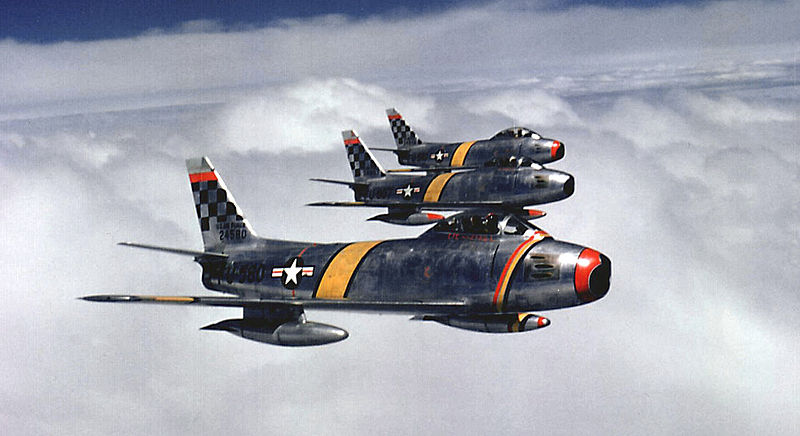
Initial proposals to meet a USAAF requirement for a single-seat high-altitude day fighter aircraft/escort fighter/fighter bomber were made in late 1944, and were originally to be derived from the design of the straight wing FJ-1 Fury being developed for the U.S. Navy. The North American P-86 Sabre was the first American aircraft to take advantage of flight research data seized from the German aerodynamicists at the end of the war. Performance requirements were met by incorporating a 35 degree swept-back wing with automatic slats into the design, using the Me 262 wing profile,Messerschmitt wing A layout and adjustable stabilizer. Manufacturing was not begun until after World War II as a result. The XP-86 prototype, which would become the F-86 Sabre, first flew on 1 October 1947 from Muroc Dry Lake, California.
The USAF Strategic Air Command had F-86 Sabres in service from 1949 through 1950. The F-86s were assigned to the 22nd Bomb Wing, the 1st Fighter Wing and the 1st Fighter Interceptor Wing.
The F-86 was produced as both a fighter-interceptor and fighter-bomber. Several variants were introduced over its production life, with improvements and different armament implemented (see below). The XP-86 (eXperimental Pursuit) was fitted with a General Electric J35-C-3 jet engine that produced 4,000 lbf (18 kN) of thrust. This engine was built by GM's Chevrolet division until production was turned over to Allison. The General Electric J47-GE-7 engine was used in the F-86A-1 producing a thrust of 5,200 lbf (23 kN) while the General Electric J73-GE-3 engine of the F-86H produced 9,250 lbf (41 kN) of thrust. The F-86 was the primary U.S. air combat fighter during the Korean War, with significant numbers of the first three production models seeing combat.
The fighter-bomber version (F-86H) could carry up to 2,000 lb (907 kg) of bombs, including an external fuel-type tank that could carry napalm.
Both the interceptor and fighter-bomber versions carried six 0.50 in (12.7 mm) M3 Browning machine guns with electrically-boosted feed in the nose (later versions of the F-86H carried four 20 mm (0.79 in) cannons instead of machine guns). Firing at a rate of 1,200 rounds per minute each, the .50 in (12.7 mm) guns were harmonized to converge at 1,000 ft (300 m) in front of the aircraft, using armor-piercing (AP) and armor-piercing incendiary (API) rounds, with one armor-piercing incendiary tracer (APIT) for every five AP or API rounds. The API rounds used during the Korean War containedmagnesium, which were designed to ignite upon impact but burned poorly above 35,000 ft (11,000 m) as oxygen levels were insufficient to sustain combustion at that height. Initially fitted with the Mark 18 manual-ranging computing gun sight, later models used the A-1CM radar ranging gunsight which used radar to compute the range of a target. This would later prove to be a significant advantage against MiG opponents over Korea.
Unguided 2.75 in (70 mm) rockets were used on some of the fighters on training missions, but 5 inch (127 mm) rockets were later carried on combat operations. The F-86 could also be fitted with a pair of external jettisonable jet fuel tanks (four on the F-86F beginning in 1953) that extended the range of the aircraft.
The F-86 Sabre was also produced under license by Canadair, Ltd., in the Province of Quebec as the Canadair Sabre. The final variant of the Canadian Sabre, the Mark 6, is generally rated as having the highest capabilities of any Sabre version made anywhere. The last Sabre to be manufactured by Canadair (Sabre #1815) is now kept in the Western Canada Aviation Museum (WCAM)'s permanent collection in Winnipeg, Manitoba, after being donated by the Pakistan Air Force.
Breaking Sound Barrier And Other Record

The F-86A set its first official world speed record of 570 m.p.h. in September 1948.
Several people involved with the development of the F-86, including the chief aerodynamicist for the project and one of its other test pilots, claimed that North American test pilot George Welch had broken the sound barrier in a dive with the XP-86 while on a test flight 1 October 1947. Chuck Yeager broke the sound barrier on 14 October 1947 in the rocket-propelled Bell X-1, thus flying first aircraft to sustain supersonic speed in level flight, making it the first "true" supersonic aircraft).
On 18 May 1953, Jacqueline Cochran flying a Canadian-built F-86E alongside Chuck Yeager became the first woman to break the sound barrier. It is unclear whether this was in level flight or not.
Operational History
Korean War

United States Air Force in 1949, joining the 1st Fighter Wing's 94th Fighter Squadron "Hat-in-the-Ring" and became the primary air-to-air jet fighter used by the Americans in the Korean War. With the introduction of the Soviet Mikoyan-Gurevich MiG-15 into air combat in November 1950, which outperformed all aircraft then assigned to the United Nations, three squadrons of F-86s were rushed to the Far East in December. Early variants of the F-86 could not outturn, but they could outdive the MiG-15, and the MiG-15 was superior to the early F-86 models in ceiling, acceleration, rate of climb, and zoom. With the introduction of the F-86F in 1953, the two aircraft were more closely matched, with many combat-experienced pilots claiming a marginal superiority for the F-86F. MiGs flown from bases in Manchuria by Red Chinese, North Korean, and Soviet VVS pilots were pitted against two squadrons of the 4th Fighter-Interceptor Wing forward-based at K-14, Kimpo, Korea.
American pilots were experienced World War II veterans, while the North Koreans and the Chinese lacked combat experience, thus accounting for much of the F-86's success. However, whatever the actual results may have been, it is clear that the F-86 pilots did not experience definitive superiority over the World-War-II-experienced, Soviet-piloted MiG-15s in Korean airspace. According to former communist sources, Soviets initially piloted the majority of MiG-15s that fought in Korea. Later in the war, North Korean and Chinese pilots increased their activity. The North Koreans and their allies periodically contested air superiority in MiG Alley, an area near the mouth of the Yalu River (the boundary between Korea and China) over which the most intense air-to-air combat took place. The F-86E's all-moving tailplane has been credited with giving the Sabre an important advantage over the MiG-15. Far greater emphasis has been given to the training, aggressiveness and experience of the F-86 pilots. American Sabre pilots were trained at Nellis, where the casualty rate of their training was so high they were told, "If you ever see the flag at full staff, take a picture." Despite rules-of-engagement to the contrary, F-86 units frequently initiated combat over MiG bases in the Manchurian "sanctuary." The hunting of MiGs in Manchuria would lead to many reels of gun camera footage being 'lost' if the reel revealed the pilot had violated Chinese airspace.
By the end of hostilities, F-86 pilots were credited with shooting down 792 MiGs for a loss of only 78 Sabres, a victory ratio of 10:1. More recent research by Dorr, Lake and Thompson has claimed the actual ratio is closer to 2:1. The Soviets claimed to have downed over 600 Sabres, together with the Chinese claims. A recent RAND report made reference to "recent scholarship" of F-86 vs. MiG-15 combat over Korea and concluded that the actual kill:loss ratio for the F-86 was 1.8:1 overall, and likely 1.3:1 against MiGs flown by Soviet pilots; however, the report has been under fire for various misrepresentations. Of the 41 American pilots who earned the designation of ace during the Korean war, all but one flew the F-86 Sabre, the exception being a Navy F4U Corsair night fighter pilot.The needs of combat operation balanced against the need to maintain an adequate force structure in Western Europe led to the conversion of the 51st Fighter-Interceptor Wing from the F-80 to the F-86 in December 1951. Two fighter-bomber wings, the 8th and 18th, converted to the F-86F in the spring of 1953. No. 2 Squadron,South African Air Force also distinguished itself flying F-86s in Korea as part of the 18 FBW.
1958 Taiwan Strait Crisis

Sabres and MiGs were shortly to battle each other in the skies of Asia once again in the Second Taiwan Strait Crisis. In August 1958, the Chinese Communists of the People's Republic of China attempted to force the Nationalists off of the islands of Quemoy and Matsu by shelling and blockade. Nationalist F-86Fs flying CAP over the islands found themselves confronted by Communist MiG-15s and MiG-17s, and there were numerous dogfights.The Republic of China Air Force of Taiwan was one of the first recipients of surplus USAF Sabres. From December 1954 to June 1956, the ROC Air Force received 160 ex-USAF F-86F-1-NA through F-86F-30-NA fighters. By June 1958, the Nationalist Chinese had built up an impressive fighter force, with 320 F-86Fs and seven RF-86Fs having been delivered.
During these battles, the Nationalist Sabres introduced a new element into aerial warfare. Under a secret effort designated Operation Black Magic, the US Navy had provided the ROC with the AIM-9 Sidewinder, its first infrared-homing air-to-air missile, which was just entering service with the United States. A small team from VMF-323, a Marine FJ-4 Fury squadron with later assistance from China Lake and North American Aviation, initially modified 20 of the F-86 Sabres to carry a pair of Sidewinders on underwing launch rails and instructed the ROC pilots in their use flying profiles with USAF F-100s simulating the MiG-17. The MiGs enjoyed an altitude advantage over the Sabres, as they had in Korea, and Communist Chinese MiGs routinely cruised over the Nationalist Sabres, only engaging when they had a favorable position. The Sidewinder took away that advantage and proved to be devastatingly effective against the MiGs.
The combat introduction of the Sidewinder took place in a battle on 24 September 1958 when ROC Sabres succeeded in destroying 10 MiGs and scoring two probables without loss to themselves. In one month of air battles over Quemoy and Matsu, Nationalist pilots tallied a score of no less than 31 MiGs destroyed and eight probables, against a loss of two F-84Gs and no Sabres. The data comes from Nationalist Air Force filmed data.
Indo-Pakistani War of 1965

During the 22-day Indo-Pakistani War of 1965 the F-86 became the mainstay of the PAF, although the Sabre was no longer a world-class fighter, since fighters with Mach 2 performance were now in service. Many sources state the F-86 gave the PAF a technological advantage, but others dispute this claim because the InAF fighters opposing it had greater performance. In 1954, Pakistan began receiving the first of a total of 120 F-86F Sabres. Many of these aircraft were the F-86F-35 from USAF stocks, but some were from the later F-86F-40-NA production block, made specifically for export. Many of the -35s were brought up to -40 standards before they were delivered to Pakistan, but a few remained -35s. The F-86 was operated by nine PAF squadrons at various times: Nos. 5, 11, 14, 15, 16, 17, 18, 19 and 26 Squadrons.
1971 Indo-Pakistani War. The F-86 proved vulnerable to the diminutive Folland Gnat, which proved to be fast, nimble and hard to see. The IAF Gnats, given the nickname "Sabre Slayer," claimed to have downed seven PAF Sabres.
Specifications

General characteristics
- Crew: 1
- Length: 37 ft 1 in (11.4 m)
- Wingspan: 37 ft 0 in (11.3 m)
- Height: 14 ft 1 in (4.5 m)
- Wing area: 313.4 sq ft (29.11 m²)
- Empty weight: 11,125 lb (5,046 kg)
- Loaded weight: 15,198 lb (6,894 kg)
- Max takeoff weight: 18,152 lb (8,234 kg)
- Powerplant: 1× General Electric J47-GE-27 turbojet, 5,910 lbf (maximum thrust at 7.950 rpm for five min) (26.3 kN)
- Fuel provisions Internal fuel load: 437 gallons (1,650 l), Drop tanks: 2 x 200 gallons (756 l) JP-4 fuel
Performance
- Maximum speed: 687 mph (1,106 km/h) at sea level at 14,212 lb (6,447 kg) combat weight
also reported 678 mph (1,091 km/h) and 599 at 35,000 feet (11,000 m) at 15,352 pounds (6,960 kg). (597 knots, 1,105 km/h at 6446 m, 1,091 and 964 km/h at 6,960 m.) - Stall speed: 124 mph (power off) (108 kt, 200 km/h)
- Range: 1,525 mi, (1,753 NM, 2,454 km)
- Service ceiling: 49,600 ft at combat weight (15,100 m)
- Rate of climb: 9,000 ft/min at sea level (45.72 m/s)
- Wing loading: 49.4 lb/ft² (236.7 kg/m²)
- lift-to-drag: 15.1
- Thrust/weight: 0.38
- Landing ground roll: 2,330 ft, (710 m)
- Time to altitude: 5.2 min (clean) to 30,000 ft (9,100 m)
Armament
- Guns: 6 × 0.50 in (12.7 mm) M2 Browning machine guns (1,602 rounds in total)
- Rockets: variety of rocket launchers; e.g: 2 × Matra rocket pods with 18× SNEB 68 mm rockets each
- Bombs: 5,300 lb (2,400 kg) of payload on four external hardpoints, bombs are usually mounted on outer two pylons as the inner pairs are wet-plumbed pylons for 2 × 200 gallons drop tanks to give the Sabre a useful range. A wide variety of bombs can be carried (max standard loadout being 2 × 1,000 lb bombs plus 2 drop tanks), napalm bomb canisters and can include a tactical nuclear weapon.

Tidak ada komentar:
Posting Komentar