
The Mikoyan MiG-29 (Russian: Микоян МиГ-29; NATO reporting name: Fulcrum) is a fourth-generation jet fighter aircraftdesigned in the Soviet Union for an air superiority role. Developed in the 1970s by the Mikoyan design bureau, it entered service with the Soviet Air Force in 1983, and remains in use by the Russian Air Force as well as in many other nations. The NATO name "Fulcrum" was sometimes unofficially used by Soviet pilots in service.
The MiG-29, along with the Sukhoi Su-27, was developed to counter new American fighters such as the McDonnell Douglas F-15 Eagle, and the General Dynamics F-16 Fighting Falcon.
DEVELOPMENT
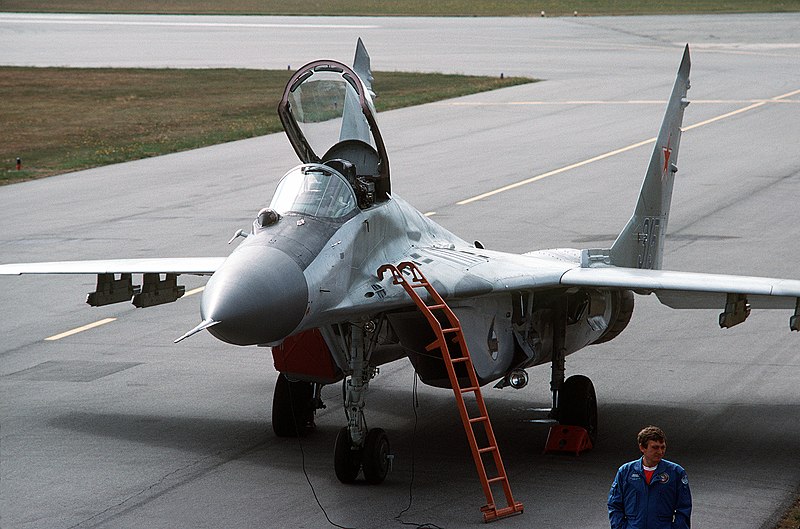
In 1969 the existence of the United States Air Force's "F-X" program, which would result in the McDonnell Douglas F-15 Eagle, became public knowledge. At the height of the Cold War, a Soviet response was necessary to avoid the possibility of a new American fighter becoming a serious technological advantage over existing Soviet fighters, thus the development of a new air superiority fighter became a priority. The Soviet General Staff issued a requirement for a Perspektivnyy Frontovoy Istrebitel (PFI, translating directly as "Perspective Frontline Fighter", roughly "Advanced Frontline Fighter"). Specifications were extremely ambitious, calling for long range, good short-field performance (including the ability to use austere runways), excellent agility, Mach 2+ speed, and heavy armament. The aerodynamic design for the new aircraft was largely carried out by the Russian aerodynamics instituteTsAGI in collaboration with the Sukhoi design bureau.
However, in 1971 Soviet studies determined the need for different types of fighters. The PFI program was supplemented with the LPFI (Perspektivnyy Lyogkiy Frontovoy Istrebitel, or "Advanced Lightweight Tactical Fighter") program; the Soviet fighter force was planned to be approximately 33% PFI and 67% LPFI. PFI and LPFI paralleled the USAF's decision that created the "Lightweight Fighter" program and the General Dynamics F-16 Fighting Falcon and Northrop YF-17. The PFI fighter was assigned to Sukhoi, resulting in the Sukhoi Su-27, while the lightweight fighter went to Mikoyan. Detailed design work on the resultant Mikoyan Product 9, designated MiG-29A, began in 1974, with the first flight taking place on 6 October 1977. The pre-production aircraft was first spotted by United States reconnaissance satellites in November of that year; it was dubbed Ram-L because it was observed at the Zhukovsky flight test center near the town of Ramenskoye. Early Western speculations suggested that the Ram-L was very similar in appearance to the YF-17 and powered by afterburningTumansky R-25 turbojets.
The workload split between TPFI and LPFI became more apparent as the MiG-29 filtered into front line service with the Soviet Air Forces(Russian: Voenno-Vozdushnye Sily [VVS]) in the mid-1980s. While the heavy, long range Su-27 was tasked with the more exotic and dangerous role of deep air-to-air sweeps of NATO high-value assets, the smaller MiG-29 directly replaced the MiG-23 in the frontal aviation role. The MiG-29 was positioned relatively close to the front lines, tasked with providing local air superiority to advancing Soviet motorized army units. Rugged landing gear and protective intake grates meant the MiG-29 could operate from the damaged or under-prepared airstrips Soviet war planners expected to encounter during a rapid armored advance. The MiG-29 was also tasked with escort duties for local strike and interdiction air packages, protecting vulnerable ground attack aircraft from NATO fighters such as the F-15 and F-16. Frontal aviation MiG-29s would ensure Soviet ground forces could operate under a safe air umbrella, moving forward with the troops as they advanced.Despite program delays caused by the loss of two prototypes in engine-related accidents (third prototype on 15 June 1978 and the fifth prototype on 31 October 1980) , the MiG-29B production version entered service in August 1983 at the Kubinka air base. State acceptance trials were completed in 1984, and deliveries began the same year to the Soviet Frontal Aviation.
In the West, the new fighter was given the NATO reporting name "Fulcrum-A" because the pre-production MiG-29A, which should have logically received this designation, remained unknown in the West at that time. The MiG-29B was widely exported in downgraded versions known as MiG-29B 9-12A and MiG-29B 9-12B (for Warsaw Pact and non-Warsaw Pact nations, respectively), with less capable avionics and no capability for delivering nuclear weapons. Total production was about 840 aircraft.
Improved versions

In the 1980s, Mikoyan developed the improved MiG-29S to use longer range R-27E and R-77 air-to-air missiles. It added a dorsal 'hump' to the upper fuselage to house a jamming system and some additional fuel capacity. The weapons load was increased to 4,000 kg (8,800 lb) with airframe strengthening. These features were included in new-built fighters and upgrades to older MiG-29s.
Refined versions of the MiG-29 with improved avionics were fielded by the Soviet Union, but Mikoyan’s multirole variants, including a carrier-based version designated MiG-29K, were never produced in large numbers. In the post-Soviet era, MiG-29 development was influenced by the Mikoyan bureau's apparent lesser political clout than rival Sukhoi. Some more advanced versions are still being pursued for export, and updates of existing Russian aircraft are likely. New fighter versions called MiG-29M/M2 and MiG-29SMT have been developed. Furthermore, development of the MiG-29K carrier version has been resumed for the Indian Navy's INSVikramaditya aircraft carrier.
The Soviet Union did not assign official names to most of its aircraft, although nicknames were common. Unusually, some Soviet pilots found the MiG-29’s NATO reporting name, "Fulcrum", to be a flattering description of the aircraft’s intended purpose, and it is sometimes unofficially used in Russian service.
DESIGN
Features

Because it was developed from the same basic parameters laid out by TsAGI for the original PFI, the MiG-29 is aerodynamically broadly similar to the Sukhoi Su-27, but with some notable differences. It is built largely out of aluminium with some composite materials. It has a mid-mounted swept wing with blended leading-edge root extensions (LERXs) swept at around 40°. There are swept tailplanes and two vertical fins, mounted on booms outboard of the engines. Automatic slats are mounted on the leading edges of the wings; they are four-segment on early models and five-segment on some later variants. On the trailing edge, there are maneuvering flaps and wingtip ailerons. At the time of its deployment, it was one of the first jet fighters in service capable of executing the Pugachev Cobra maneuver.The MiG-29 has hydraulic controls and a SAU-451 three-axis autopilot but, unlike the Su-27, no fly-by-wire control system. Nonetheless, it is very agile, with excellent instantaneous and sustained turn performance, high-alpha capability, and a general resistance to spins. The airframe is stressed for 9-g (88 m/s²) maneuvers. The controls have "soft" limiters to prevent the pilot from exceeding the g and alpha limits, but these can be disabled manually.
Powerplant

The MiG-29 has two widely spaced Klimov RD-33 turbofan engines, each rated at 50.0 kN (11,240 lb) dry and 81.3 kN (18,277 lb) inafterburner. The space between the engines generates lift, thereby reducing effective wing loading, to improve maneuverability. The engines are fed through wedge-type intakes fitted under the leading-edge extensions (LERXs), which have variable ramps to allow high-Mach speeds. As an adaptation to rough-field operations, the main air inlet can be closed completely and alter using the auxiliary air inlet on the upper fuselage for takeoff, landing and low-altitude flying, preventing ingestion of ground debris. Thereby the engines receive air through louvers on the LERXs which open automatically when intakes are closed. However the latest variant of the family, the MiG-35, eliminated these dorsal louvers, and adopted the mesh screens design in the main intakes, similar to those fitted to the Su-27.
Range and fuel system

The internal fuel capacity of the original MiG-29B is only 4,365 litres distributed between six internal fuel tanks, four in the fuselage and one in each wing. As a result, the aircraft has a very limited range, in line with the original Soviet requirements for a point-defense fighter. For longer flights, this can be supplemented by a 1,500-litre (330 Imp gal, 395 US gal) centreline drop tank and, on later production batches, two 1,150-litre (253 Imp gal, 300 US gal) underwing drop tanks. In addition, a small number have been fitted with port-sideinflight refueling probes, allowing much longer flight times by using a probe-and-drogue system. Some MiG-29B airframes have been upgraded to the "Fatback" configuration (MiG-29 9–13), which adds a dorsal-mounted internal fuel tank. Advanced variants, such as the MiG-35, can be fitted with a conformal fuel tank on the dorsal spine, although none of them have yet entered service.
Cockpit
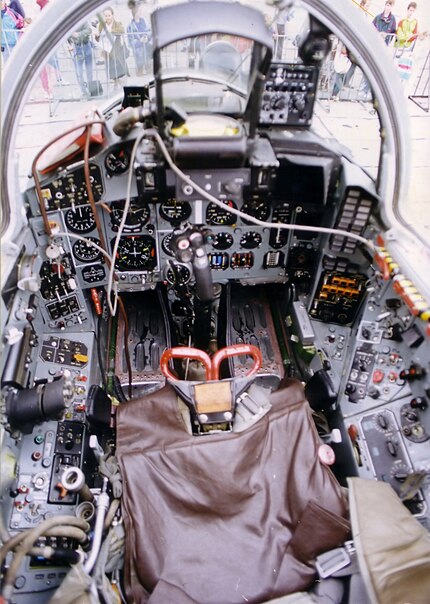
The cockpit has conventional dials, with a head-up display (HUD) and a Shchel-3UM helmet mounted display, but no HOTAS ("hands-on-throttle-and-stick") capability. Emphasis seems to have been placed on making the cockpit similar to the earlier MiG-23 and other Soviet aircraft for ease of conversion, rather than on ergonomics. Nonetheless, the MiG-29 does have substantially better visibility than most previous Russian jet fighters, thanks to a high-mounted bubble canopy. Upgraded models introduce "glass cockpits" with modern liquid-crystal (LCD)multi-function displays (MFDs) and true HOTAS.The cockpit features a conventional centre stick and left hand throttle controls. The pilot sits in a Zvezda K-36DM zero-zero ejection seat which has had impressive performance in emergency escapes.
Sensors

The baseline MiG-29B has a Phazotron RLPK-29 (Radiolokatsyonnui Pritselnui Kompleks) radar fire control system (FCS) which includes the N019 (Sapfir 29; NATO: 'Slot Back') look-down/shoot-down coherent pulse-Doppler radar and the Ts100.02-02 digital computer. Tracking range against a fighter-sized target was only about 70 km (38 nmi) in the frontal aspect and 35 km (19 nmi) in the rear aspect. Range against bomber-sized targets was roughly double. Ten targets could be displayed in search mode, but the radar had to lock onto a single target forsemi-active homing (SARH). The MiG-29 was not able to reliably utilize the new Vympel R-27R (NATO: AA-10 "Alamo") long-range SARH missile at its maximum ranges.
These performance deficiencies stemmed largely from the fact the N019 radar was not, in fact, a new design. Instead, the system was a further development of the architecture already used in Phazotron's Sapfir-23ML system, then in use on the MiG-23ML. During the initial MiG-29 design specification period in the mid-1970s, Phazotron NIIR was tasked with producing a modern radar for the MiG-29. To speed development, Phazotron based its new design on the work undertaken by NPO Istok on the experimental "Soyuz" radar program. Accordingly, the N019 was originally intended to have a flat planar array antenna and full digital signal processing, giving a detection and tracking range of at least 100 km against a fighter-sized target. Given the state of Soviet avionics technology at the time, it was an ambitious goal. Testing and prototypes soon revealed this could not be attained in the required timeframe, at least not in a radar that would fit in the MiG-29's nose. Rather than design a completely new, albeit more modest radar, Phazotron reverted to a version of the twisted-polarization Cassegrain antenna used successfully on the Sapfir-23ML to save time and cost. This system used the same analog signal processors as their earlier designs, coupled with a NII Argon-designed Ts100 digital computer. While this decision provided a working radar system for the new fighter, it inherited all of the weak points of the earlier design. This reliance on 1960s-era technology continued to plague the MiG-29's ability to detect and track airborne targets at ranges available with the R-27 and R-77 missiles, although new designs like the digital N010 Zhuk-M address the serious signal processing shortcomings inherent in the analog design. Most MiG-29 continue to use the analog N019 or N019M radar, although VVS has indicated its desire to upgrade all existing MiG-29s to a fully digital system.
The N019 was further compromised by Phazotron designer Adolf Tolkachev’s betrayal of the radar to the CIA, for which he was executed in 1986. In response to all of these problems, the Soviets hastily developed a modified N019M Topaz radar for the upgraded MiG-29S aircraft. However, VVS was reportedly still not satisfied with the performance of the system and demanded another upgrade. The latest upgraded aircraft offered the N010 Zhuk-M, which has a planar array antenna rather than a dish, improving range, and a much superior processing ability, with multiple-target engagement capability and compatibility with the Vympel R-77 (or RVV-AE) (NATO: AA-12 'Adder'). A useful feature the MiG-29 shares with the Su-27 is the S-31E2 KOLS, a combined laser rangefinder and IRST in an "eyeball" mount forward of the cockpit canopy. This can be slaved to the radar or used independently, and provides exceptional gun-laying accuracy.
Armament

Armament for the MiG-29 includes a single GSh-30-1 30 mm cannon in the port wing root. This originally had a 150-round magazine, which was reduced to 100 rounds in later variants. Original production MiG-29B aircraft cannot fire the cannon when carrying a centerline fuel tank as it blocks the shell ejection port. This issue was corrected in the MiG-29S and later versions. Three pylons are provided under each wing (four in some variants), for a total of six (or eight). The inboard pylons can carry either a 1,150-litre (300 US gal) fuel tank, one Vympel R-27 (AA-10 "Alamo") medium-range air-to-air missile, or unguided bombs or rockets. Some Soviet aircraft could carry a single nuclear bomb on the port inboard station. The outer pylons usually carry R-73 (AA-11 "Archer") dogfight missiles, although some users still retain the older R-60 (AA-8 "Aphid"). A single 1,500-litre (400 US gal) tank can be fitted to the centerline, between the engines, for ferry flights, but this position is not used for combat stores. The original MiG-29B can carry general-purpose bombs and unguided rocket pods, but not precision-guided munitions. Upgraded models have provision for laser-guided and electro-optical bombs, as well as air-to-surface missiles.
SPECIFICATIONS

General characteristics
- Crew: 1
- Length: 17.37 m (57 ft)
- Wingspan: 11.4 m (37 ft 3 in)
- Height: 4.73 m (15 ft 6 in)
- Wing area: 38 m² (409 ft²)
- Empty weight: 11,000 kg (24,250 lb)
- Loaded weight: 16,800 kg (37,000 lb)
- Max takeoff weight: 21,000 kg (46,300 lb)
- Powerplant: 2 × Klimov RD-33 afterburning turbofans, 8,300 kgf (81.4 kN, 18,300 lbf) each
Performance
- Maximum speed: Mach 2.25 (2,400 km/h, 1,490 mph) At low altitude: Mach 1.25 (1,500 km/h, 930 mph)
- Range: 1,430 km (772 nmi, 888 mi) with maximum internal fuel
- Ferry range: 2,100 km (1,300 mi) with 1 drop tank
- Service ceiling: 18,013 m (59,100 ft)
- Rate of climb: initial 330 m/s average 109 m/s 0–6000 m (65,000 ft/min)
- Wing loading: 442 kg/m² (90.5 lb/ft²)
- Thrust/weight: 1.01
Armament
- 1 x 30 mm GSh-30-1 cannon with 150 rounds
- 7 Hard points: 6 x pylons under-wing, 1 x under fuselage
- Up to 3,500 kg (7,720 lb) of weapons including six air-to-air missiles — a mix of semi-active radar homing (SARH) and AA-8 "Aphid", AA-10 "Alamo", AA-11 "Archer", AA-12 "Adder", FAB 500-M62, FAB-1000, TN-100, ECM Pods, S-24, AS-12, AS-14
Avionics
- Phazotron N019, N010 radars

Tidak ada komentar:
Posting Komentar